SRRExecutive Advisory
Back to the library
S.T.E.P. / performance

Why Advisors Leaving Should Be a Non-Event

Last updated: September 2026

The S.T.E.P. Performance framework tests whether external support actually transfers capability, or only delivers output while the engagement lasts. Its centerpiece, the Capability Endurance Protocol, was enforced across mandates including TIM, using three gates — named-owner, shadow-delivery, and sign-off — designed before delivery begins, not retrofitted afterward.

Transfer must be designed before delivery begins.

A client-side protocol for making capability transfer measurable, owned and complete before the final advisor invoice is paid.

UniCredit + TIM · capability endurance governed client-side
04S.T.E.P. Execution Architecture™ — performance ebook cover
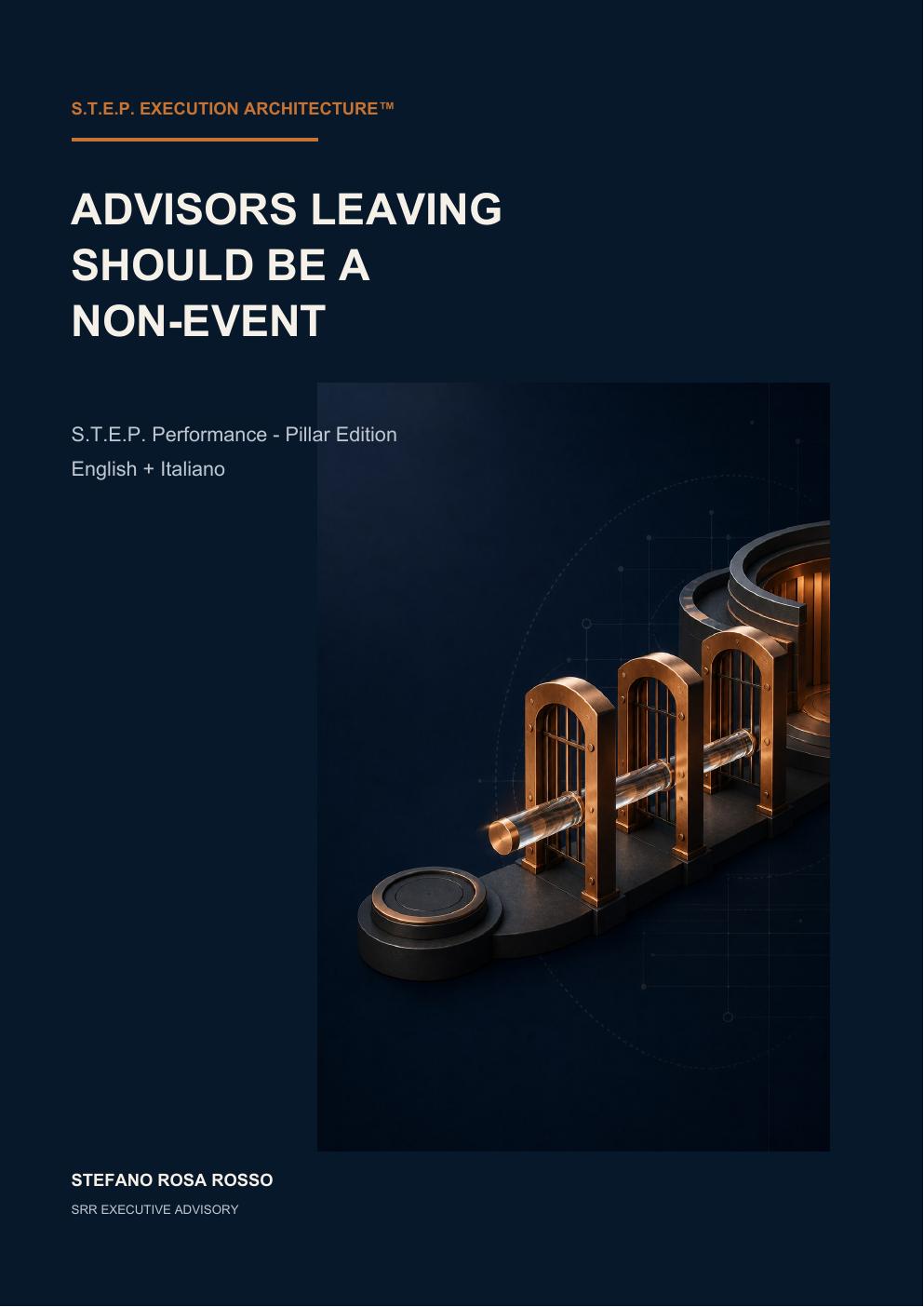
Transfer must be designed before delivery begins.

  • The Capability Endurance Protocol
  • Capability or Dependency?
  • When Should Advisors Leave?
  • Scale Is a Governance Model
  • Five Questions Before You Approve a Reorg

Questions a Board should be able to close.

What is the Capability Endurance Protocol?

A three-gate discipline for advisory engagements: a Named-Owner Gate before the mandate starts, a Shadow-Delivery Gate where the internal team runs the process while advisors correct from the sidelines, and a Sign-Off Gate where the internal team owns the KPI before the final invoice is paid.

How do you tell capability from dependency after a consulting engagement?

Test in a room without the advisor: can the internal team produce and explain the KPI from underlying data, handle exceptions without recalling the advisor, and correct performance drift through its own governance?

When should external advisors leave an organization?

When their absence stops changing performance, not when deliverables are complete. Before the engagement ends, run a controlled-absence period where internal owners operate the process alone.

Why is scale a governance model, not just growth?

Every new relationship adds revenue potential and operating ambiguity. Scaling safely requires a legible partner economic model, clear authority, shared performance evidence, escalation for channel conflict, and exit rights.

What capability risks should a reorg check for?

Whether the new structure preserves shadow-delivery relationships, who owns each KPI from day one, and what evidence beyond an org chart proves the new structure is ready before go-live.

How do you measure whether a transformation programme actually transferred capability?

By testing whether performance holds during deliberate advisor absence, whether the internal team formally owns the KPI before final payment, and whether exceptions resolve through internal governance.

Stefano Rosa Rosso brings client-side executive responsibility since 1995, including governance mandates spanning UniCredit and TIM, and has managed approximately €500M of technology spend across strategy, transformation, and sourcing programmes. He is the creator of the S.T.E.P. Execution Architecture™ framework and founder of SRR Executive Advisory. LinkedIn

06 / Preview

Selected pages

S.T.E.P. Diagnostic™

Find where execution is exposed before the variance report does.

Discuss a diagnostic